


By Max Suspension · B2B sourcing and product guides
Coilover MOQ depends on what must be produced together: the application, damper configuration, spring specification, finish, branding and packaging. A supplier’s order-level minimum does not necessarily mean every combination can be mixed freely within that quantity.
For a wholesale buyer, the useful question is therefore: “What minimum applies to each part of this project, and what changes on replenishment?” Request that breakdown before widening your first application list.
There may be more than one minimum
An existing kit with standard packaging and a new private-label configuration create different purchasing tasks. The latter may need custom components or printed materials even when the damper platform already exists.
| MOQ layer | Ask the supplier | Why it affects your stock plan |
|---|---|---|
| Finished order | Can different applications share an order? | Determines the overall buying commitment |
| Application/SKU | Is there a minimum for each vehicle kit? | Controls how broadly you can launch |
| Specification | Do spring or damper changes create separate batches? | Variants can divide otherwise shared volume |
| Finish/branding | Does each color or marking have its own minimum? | Cosmetic choice can add inventory |
| Printed packaging | Who owns unused cartons or labels? | Material stock may outlast finished kits |
| Replenishment | Does the same minimum apply to repeat orders? | Determines whether slow sellers remain serviceable |
These are questions to resolve, not universal rules for every manufacturer. As one industry example, Progress’s private-label page distinguishes its stated order minimum from potential setup and prototype charges. Its terms are specific to that supplier and should not be used as Max Suspension’s MOQ.
How a mixed-application order can become misleading
Consider a hypothetical launch of 60 kits across six applications. An order minimum of 60 tells you nothing about whether you can buy ten of each, whether one application needs a separate batch, or whether three color options divide the quantity again.
Build an order matrix before negotiating. Put applications in rows and configurations in columns, then enter the quantity you actually expect to sell. Ask the supplier to mark which cells can share components or production planning. You can then see whether the constraint is total volume, application variety or a custom item.
Do not increase every SKU to an identical quantity just to make the spreadsheet look tidy. Your first order should reflect channel demand and the applications you can support, subject to an agreed manufacturing arrangement.
Reduce complexity before asking for an exception
A focused trial order can be easier to discuss than a small order with many bespoke details. Possible approaches include fewer launch applications, one approved finish, a standard carton with a controlled label, or postponing a second spring specification until demand is clearer.
Ask which change would actually reduce the minimum. Removing a printed sleeve will not solve a minimum driven by a dedicated spring batch. Likewise, accepting standard colors may help finishing economics but leave application-specific mounting parts unchanged.
Use our private-label development guide to separate essential launch features from later options. Product identity and fitment accuracy should remain intact when simplifying the offer.
Keep samples separate from commercial MOQ
Sample availability is a different question from production MOQ. A sample may require special assembly or parts procurement and should have its own price, timing and configuration record. Agree whether sample charges are credited later; do not assume that they are.
Most importantly, do not let a sample exception become an implied promise that every repeat order can be supplied in the same quantity. Ask for both the initial production minimum and the replenishment arrangement in writing.
Price the remaining material, not just the shipped kits
If a project needs more printed boxes than finished kits, decide who pays for the balance, where it is stored and what happens after an artwork revision. The same discussion may apply to special-color parts or labels.
Record ownership, storage expectations, revision control and release instructions. Otherwise a future rebrand can leave both parties disagreeing about whether old material may still be used. Our packaging brief includes a place for these decisions.
What to send for a project-specific MOQ review
Provide quantities by application, first-order timing, expected reorder frequency and the customization you actually need. Separate a forecast from a purchase commitment. Ask for options with their tradeoffs, such as fewer applications initially or standard packaging during evaluation.
Browse the Max Suspension product range and request a wholesale MOQ review. We need the proposed application mix and branding scope to discuss a useful minimum; a single universal number would leave too many project details unanswered.
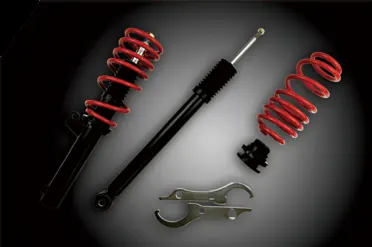
Cover: AI-generated editorial illustration based on Max Suspension product imagery. Refer to the confirmed specification for actual product details.